

- This event has passed.
Ancient Skies, Modern Eyes: Museum of Space History and Jornada Research Institute Present Free Archaeoastronomy Program on Creekside Village Great Kiva
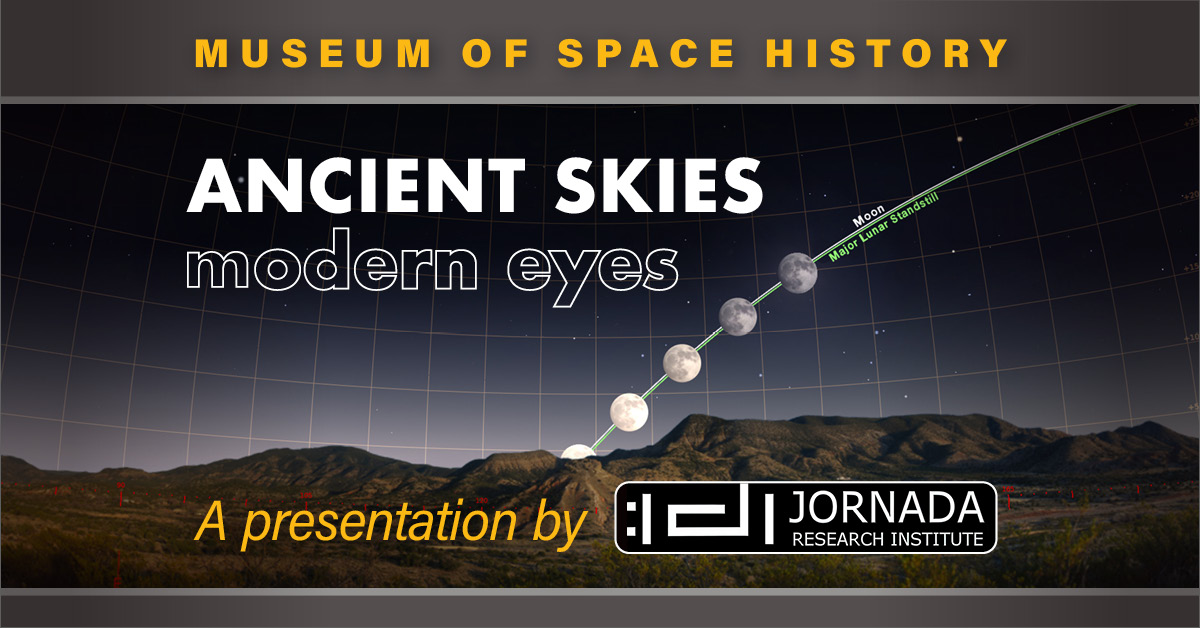
(ALAMOGORDO, NM) – The New Mexico Museum of Space History, in collaboration with Jornada Research Institute, will host a special free public presentation, “ASTRONOMICAL ASSOCIATIONS OF THE CREEKSIDE VILLAGE GREAT KIVA AND THE AGRICULTURAL CYCLE,” on Sunday, April 12, 2026, at 2:30 p.m. in the New Horizons Dome Theater as part of the museum’s annual Archaeoastronomy outreach program. The presentation will last approximately 1.5 hours and will be followed by a question‑and‑answer session; regular theater programming will be suspended during this time.
Archaeologist David H. Greenwald, President and Director of Jornada Research Institute, will demonstrate how the Creekside Village great kiva in Tularosa Canyon functioned as an astronomical observatory and horizon calendar. Using the eastern horizon as viewed from the great kiva, Greenwald will show how specific celestial events, including solstices and key lunar positions, were tracked to guide agricultural activities, a practice that continues today among Hopi, Zuni, Acoma, and other Pueblo peoples of the American Southwest.
“Between the physical archaeological remains and the implications from these remains, Creekside Village may be one of the most important sites of this time period yet studied in New Mexico,” said Greenwald. “The information we continue to gather is astounding.”
Greenwald has focused on the archaeology of the Southwestern United States for the past 50 years, conducting research on Hohokam, Basketmaker, and Pueblo groups in Arizona, Colorado, and New Mexico. After moving to Tularosa in 1997, he founded Jornada Research Institute in 2012, leading its mission to investigate the prehistory and history of the Tularosa Basin and surrounding areas. His research emphasizes sedentism and agriculture in the American Southwest, including farming strategies, architecture, and the use of interior and exterior space.
In 2004, Greenwald discovered Creekside Village in Tularosa Canyon. Initial surface indications suggested a site far more complex than any other known in the Tularosa Basin from the Mesilla phase (AD 200–1000), and subsequent Jornada Research Institute investigations have revealed dispersed pithouse villages with great kivas, irrigation systems, terraced agricultural fields, and reservoirs dating to approximately AD 600–900. The great kivas identified at Creekside Village are the first recognized in the Tularosa Basin, and some were used as celestial observatories; the irrigation systems emulate those found in Hohokam communities of southern Arizona, although at a smaller scale.
Through continued JRI‑led research, Greenwald and his colleagues determined that the Creekside Village great kiva was used to monitor the movements of the sun and moon, tying celestial observations directly to agricultural cycles. These findings form the basis of his upcoming presentation at the New Mexico Museum of Space History, where the Museum and Jornada Research Institute will bring this observatory and its cultural significance to the forefront of current archaeoastronomy studies.
This collaborative event is free and included with regular museum admission, with seating available on a first‑come, first‑served basis in the New Horizons Dome Theater. For more information about this program or the museum’s annual Archaeoastronomy program, please contact the New Mexico Museum of Space History.