
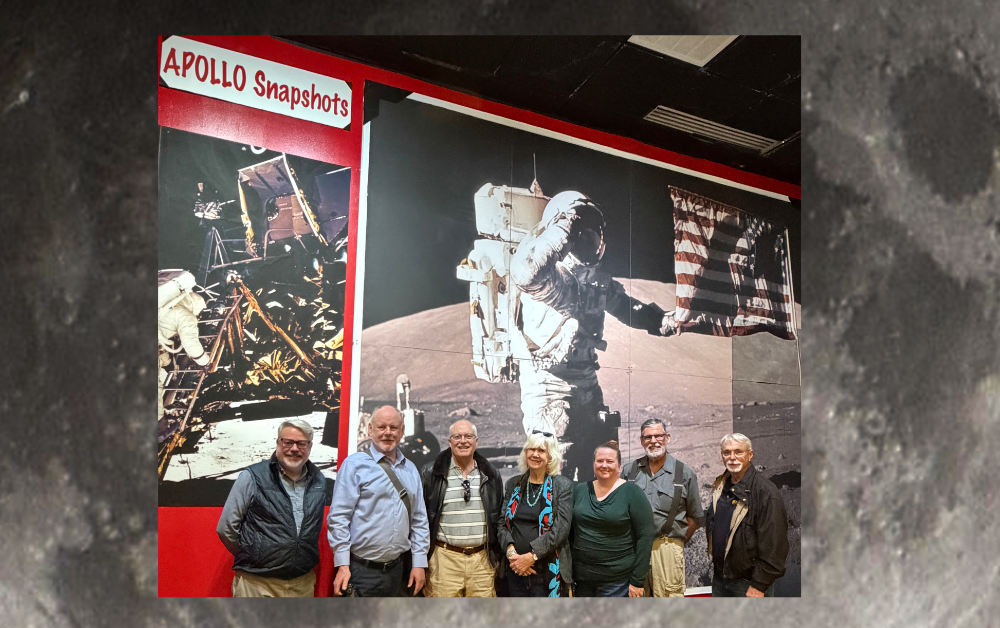
IRecently, the New Mexico Museum of Space History hosted attendees of the ICOMOS (International Council on Monuments and Sites) conference, with Dr. Beth O’Leary leading the event. Delegates from ICOMOS International Scientific Committee on Aerospace Heritage (ISCoAH) explored the museum; they were immersed in New Mexico’s pivotal role in the story of space exploration. From the early rocket tests at White Sands to the historic Apollo missions, the museum’s exhibits beautifully showcase the journey of human ambition and ingenuity. Each gallery inspires awe about our drive to explore beyond our planet.
Tour organizer and College Professor Emerita at New Mexico State University, Dr. Beth O’Leary, is a pioneer in space archaeology. Her work started in 2000 when a student’s question about how preservation law applied to the Moon sparked her mission to preserve and protect historic lunar sites, especially Apollo 11’s Tranquility Base. Thanks to Dr. O’Leary’s efforts, Tranquility Base is now listed as an archaeological site in New Mexico’s Archaeological Records Management System (ARMS), the country’s largest archaeological database.
The delegation was also welcomed by Jon Haas, Chair of the New Mexico Museum of Space History Governor’s Commission and a recent NASA retiree. Haas’s career as Principal Engineer at the NASA Engineering and Safety Center, located at Johnson Space Center’s White Sands Test Facility, underscores the state’s strong connections to aerospace innovation and safety. Under his leadership, the Governor’s Commission supports the museum’s stewardship of traditional artifacts of the Space Age and the compelling story of humanity’s first steps on another world.
The fact that delegates from ICOMOS chose to visit our museum for their International Conference underscores our museum’s importance. ICOMOS and the International Scientific Committee on Aerospace Heritage (ISCAH) have worked together to nominate the Moon as a 2025 World Monuments Watch site, recognizing it as one of 25 global heritage sites facing urgent preservation challenges. Being included in this prestigious list opens doors for support from the World Monuments Fund and raises awareness about the significance of historic lunar sites.
Additionally, the New Mexico Museum of Space History hosts LA 2,000,000, which marks the precise location on the Moon where Apollo astronauts landed on July 20, 1969—238,857 miles from Earth at lunar coordinates 0.67266° N, 23.47298° E. A plaque on the museum grounds commemorates LA 2,000,000, creating a lasting link between New Mexico and one of humanity’s greatest space achievements.
The New Mexico Museum of Space History is proud to have hosted ICOMOS, ISCAH, Dr. Beth O’Leary, and Jon Haas, and to share New Mexico’s role in safeguarding humanity’s legacy on the Moon with visitors from around the world.