
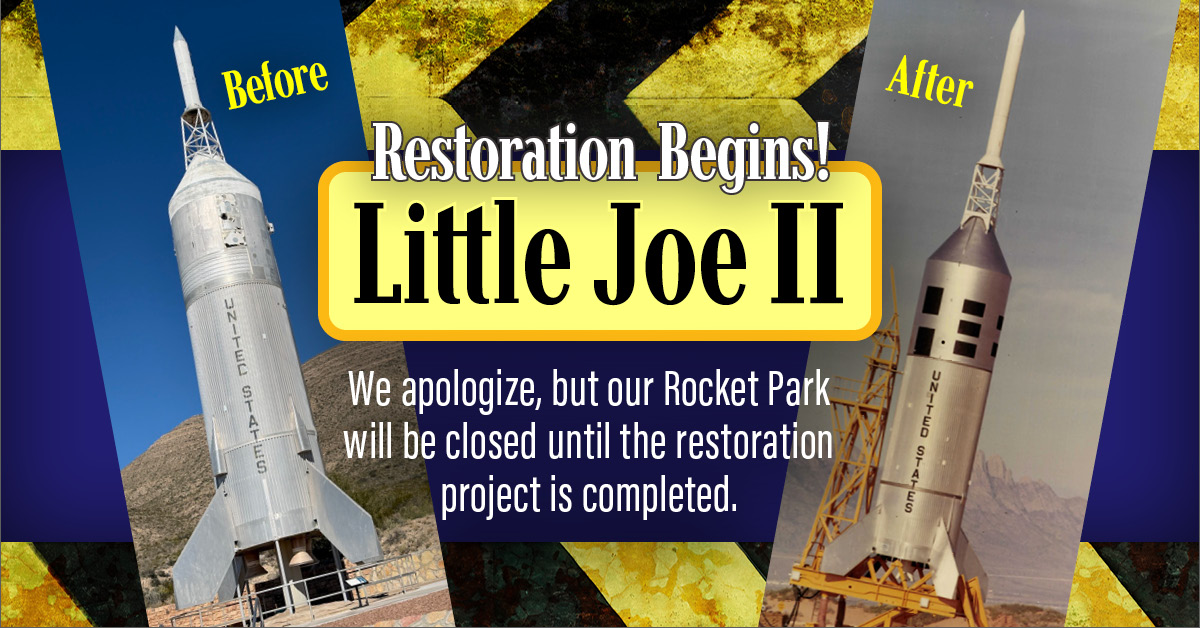
The New Mexico Museum of Space History’s Rocket Park and the adjacent playground will be temporarily closed to the public to ensure the safety of the public while the largest rocket, the Little Joe II rocket, undergoes refurbishment.
Received by the museum in 1985, Little Joe II is one of only two known surviving rockets of its kind. Standing 86 feet tall and weighing about 41,000 pounds, the rocket’s corrugated aluminum body has endured decades of exposure to the desert environment. To preserve this historic artifact, restoration specialists from Blast Off, Inc. will work on it for up to 90 days.
Tested between 1963 and 1966 at White Sands Missile Range, Little Joe II played a crucial role in preparing for the Apollo program by testing the spacecraft’s Launch Escape System (LES) and verifying the Command Module’s parachute recovery system during abort scenarios. The solid-fueled rocket, powered by nine motors, launched “boilerplate” test spacecraft on trajectories that simulated Apollo-Saturn in‑flight emergencies. During these simulated aborts, the LES successfully separated the Apollo Command Module from the booster, proving the escape system’s effectiveness and paving the way for safe human spaceflight.
For those interested in seeing Little Joe II in action, archival launch footage is available on YouTube: https://www.youtube.com/watch?v=cGxZ3Jvzkmo&t=182s.
Fun Fact: The name “Little Joe” was provided by NASA engineer and Mercury capsule designer Max Faget. He said the rocket’s four large fins reminded him of the “Little Joe” roll in the dice game “Craps.” In craps, “Little Joe” is a Hard 4-or- two twos.
The Little Joe II’s restoration ensures that future generations can continue to appreciate its vital role in the testing that made the Apollo program—and human lunar exploration—possible. The museum looks forward to welcoming visitors back to Rocket Park once the work is complete.